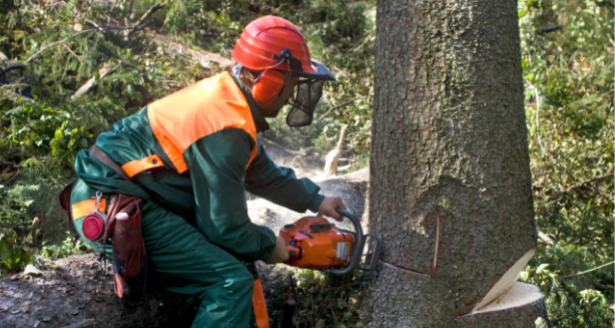
Large, mature trees can be valuable features within a garden, but their size can sometimes become difficult to accommodate. Branches may extend further across the available space, the crown can become increasingly dominant, and individual limbs may begin interfering with areas that were previously clear. This does not necessarily mean the tree needs to be removed.
For property owners in Gillingham, Kent, crown reduction can provide a practical way of managing certain large trees while retaining their established character. The process involves selectively shortening branches to reduce the height, spread or overall dimensions of the crown without simply cutting the tree back indiscriminately.
However, crown reduction is not appropriate for every large tree. The tree’s species, condition, structure, previous pruning and available growing space all need to be considered. A professional assessment helps determine whether crown reduction will provide a worthwhile improvement and how much reduction is appropriate.
How Can Crown Reduction Help Manage a Large Tree?
Crown reduction can make a large tree more manageable by reducing selected parts of its canopy while retaining a balanced overall structure.
Depending on the problem, the work may concentrate on reducing lateral spread, managing height, shortening overextended limbs or decreasing the overall dimensions of the crown.
The objective is not simply to make the tree as small as possible. Effective crown reduction aims to achieve a specific improvement while retaining suitable branches and foliage for future growth.
What Exactly Is Tree Crown Reduction?
Crown reduction is a form of professional tree pruning that decreases the size of a tree’s canopy.
Selected branches are shortened back to suitable growth points throughout the crown. The amount and location of the pruning depend on what needs to be achieved.
A reduction may involve the complete crown, or greater attention may be given to particular sections where excessive growth is causing difficulty.
The finished tree should retain a natural and proportionate form rather than appearing abruptly cut back.
Large Trees Do Not Automatically Need Felling
One of the most important points when dealing with a large tree is that size alone does not mean removal is necessary.
A mature tree can remain in suitable condition while simply becoming too large for the space comfortably available around it.
If the main concern is excessive crown size rather than significant deterioration, crown reduction may provide an alternative to felling.
Professional assessment can determine whether retaining and managing the tree remains realistic.
Crown Spread Is Often the Main Problem
When homeowners describe a tree as too large, height is not always the real concern.
Lateral branches may have extended significantly across the garden, reducing usable space or beginning to dominate particular areas.
In this situation, reducing the spread of the crown may provide a more meaningful improvement than concentrating heavily on height.
Identifying which dimensions are causing the difficulty allows the work to be more targeted.
Crown Reduction Can Recover Useful Garden Space
A large canopy can gradually occupy a significant proportion of a garden.
As outer branches extend, areas beneath and around the tree may feel increasingly restricted.
Careful crown reduction can bring suitable branches back into better proportion with the available space.
The objective should not be to create an unnaturally small tree but to establish a more practical relationship between the crown and the garden surrounding it.
Overextended Branches Can Be Managed
Some trees develop individual limbs that project considerably further than the rest of the canopy.
These overextended branches can make the complete tree appear unbalanced and may create most of the practical inconvenience.
In some situations, selective branch reduction rather than complete crown reduction may be sufficient.
This is why assessment should come before deciding on the pruning specification. The entire tree should not be reduced unnecessarily when only particular branches require attention.
Crown Reduction Can Improve Proportion
Trees do not always grow evenly.
Available light, surrounding vegetation and previous pruning can influence how individual branches develop.
One part of a crown may become considerably more prominent than another.
Selective reduction can help manage these areas and bring the canopy into better proportion.
This does not mean creating perfect symmetry. Mature trees naturally have individual forms, and appropriate pruning should work with those characteristics rather than trying to create an artificial shape.
Managing Height Requires Careful Pruning
Where height genuinely needs to be reduced, the work should be carefully planned.
Simply cutting major upper branches at arbitrary points is very different from professional crown reduction.
Suitable branches are selected and shortened to appropriate growth points so that a functioning crown remains.
The amount of height that can reasonably be removed depends on the individual tree.
Attempting an excessive reduction in a single operation can create unnecessary stress and may lead to undesirable regrowth.
More Reduction Is Not Necessarily Better
It is understandable to think that making a tree considerably smaller will mean it takes longer before further maintenance is required.
Trees do not necessarily respond this way.
Some species can produce vigorous new shoots following heavy pruning. Excessive cutting can therefore create substantial regrowth rather than providing a permanently smaller crown.
A proportionate reduction considers how the tree is likely to respond afterwards.
Trees Continue Growing After Crown Reduction
Crown reduction is not a permanent way of fixing a tree at one particular size.
The tree remains alive and continues developing.
New shoots and branches will gradually extend from the remaining crown, and the rate of growth will vary according to the tree.
This should be considered from the beginning.
Good crown management plans for future development rather than focusing solely on the appearance immediately after pruning.
Different Tree Species Respond Differently
Not every tree reacts to pruning in the same way.
Species vary in their natural crown forms, growth rates and responses to branch removal.
A reduction that is suitable for one tree may be inappropriate for another.
Professional tree surgery takes these characteristics into account when deciding how much growth can reasonably be removed and where pruning cuts should be made.
The Condition of the Tree Matters
Before reducing a large crown, the overall condition of the tree should be assessed.
A large tree with a suitable structure and healthy crown presents a very different situation from one containing substantial deterioration, damaged major branches or other significant concerns.
Crown reduction is primarily a management technique. It should not automatically be used as a response to every tree problem.
Where condition is the main concern, a different form of tree surgery may be more appropriate.
Mature Trees Need a Proportionate Approach
Large mature trees may contain substantial limbs that have developed over many years.
Removing large amounts of established growth represents a significant intervention.
For this reason, mature trees should be approached carefully.
A modest, well-planned reduction can sometimes provide the required improvement while preserving much of the established crown.
Trying to transform a mature tree dramatically in one operation may be neither necessary nor desirable.
Previous Pruning Can Influence Crown Reduction
A tree’s pruning history is important when planning further work.
Previous reductions can create areas of regrowth around old pruning points. In some cases, these shoots become dense and vigorous.
Before carrying out another reduction, the existing regrowth and previous cuts should be assessed.
Automatically cutting back to exactly the same points each time may not provide the most appropriate long-term management.
Heavy Previous Cutting Can Create Complicated Regrowth
Trees that have been cut back severely in the past can sometimes develop numerous vigorous shoots.
These may eventually create a dense crown that appears to require another substantial reduction.
Repeated heavy cutting can then create an ongoing cycle.
Professional tree management considers how this regrowth should be handled rather than simply repeating the same severe treatment.
In some situations, gradual selective management can provide a more appropriate approach.
Crown Reduction Is Different From Tree Topping
Professional crown reduction should not be confused with indiscriminately removing the upper parts of a tree.
Crown reduction uses selected pruning points and aims to retain a balanced framework.
Arbitrary topping can leave major branches abruptly shortened without sufficient consideration of the resulting structure or future growth.
Although both methods may initially produce a smaller tree, the long-term outcomes can be very different.
Crown Reduction Can Help With Light Levels
A very large canopy can influence how much daylight reaches areas beneath and around the tree.
Reducing appropriate sections of the crown may help create a more open relationship between the tree and the surrounding garden.
However, crown reduction should not be treated as a guarantee of dramatically increased light.
The position of the tree, density of foliage and direction of the canopy all influence the result.
Where light is the main concern, the tree should be assessed specifically with that objective in mind.
Crown Thinning Is Not the Same as Crown Reduction
Crown thinning and crown reduction have different purposes.
Reduction decreases the dimensions of the canopy.
Thinning selectively removes branches from within the crown while generally retaining its overall height and spread.
If a tree is simply occupying too much physical space, thinning alone may not solve the problem because the outer dimensions remain largely unchanged.
Choosing the correct technique depends on what needs to be improved.
Crown Lifting Can Sometimes Be a Better Solution
Sometimes the tree is not actually too large overall.
The difficulty may be caused by low branches extending into frequently used parts of the garden.
Where appropriate, crown lifting can increase clearance beneath the canopy by managing selected lower branches.
If low growth is the main concern, reducing the complete crown may be unnecessary.
Professional assessment helps identify whether crown reduction, crown lifting or selective pruning provides the most targeted solution.
Selective Pruning May Be Enough
A tree should not receive complete crown reduction simply because a few branches are inconvenient.
Where the problem is limited to individual limbs, selective pruning can retain substantially more of the existing crown.
This can be particularly useful when one side of a tree has extended further than the rest.
Targeting the actual problem helps keep tree surgery proportionate.
Deadwood Removal Has a Different Purpose
A large tree may also contain dead branches, but deadwood management is separate from crown reduction.
Removing dead branches does not necessarily reduce the dimensions of the healthy canopy significantly.
Where both issues exist, the work can be considered together while maintaining a clear distinction between managing crown size and addressing deadwood.
This ensures healthy branches are not removed unnecessarily simply because other parts of the tree require attention.
Crown Reduction Can Help Manage Trees Near Garden Features
As trees grow, branches can gradually extend towards paths, patios, lawns and other frequently used parts of a garden.
Where suitable, crown reduction can increase separation between the canopy and these areas.
The work should focus on the sections actually creating the difficulty.
This targeted approach can make the garden easier to use while retaining the tree as an established feature.
Garden Layout Should Influence the Pruning Specification
The same tree can create very different management requirements depending on its surroundings.
A broad crown may be perfectly acceptable where there is sufficient open space but more difficult to accommodate in a restricted garden.
Before recommending reduction, it is useful to understand which areas need greater clearance and how the garden is normally used.
This allows the pruning specification to respond to practical requirements rather than reducing the tree without a clear objective.
Several Large Trees Should Be Considered Together
Where multiple trees occupy the same garden, their crowns can begin overlapping as they mature.
Reducing every tree by exactly the same amount may not produce the best outcome.
One may need its spread reduced, another may only require selective pruning, while another may currently need no significant work.
Assessing the trees together can help create more appropriate spacing without unnecessary pruning.
Crown Reduction Can Form Part of Long-Term Tree Management
For some trees, crown reduction is most effective when considered as part of an ongoing management strategy.
After the initial reduction, the tree can be observed as it produces new growth.
Future pruning can then respond to how the crown develops.
This is different from allowing the tree to become extremely large again before carrying out another severe reduction.
Planned management can help maintain more consistent dimensions over time.
Planned Management Does Not Mean Constant Pruning
A managed tree does not necessarily need cutting every year.
The appropriate interval depends on the tree, the amount of reduction, its growth rate and the reason for managing its size.
Periodic assessment can establish whether further work is actually necessary.
If the crown remains suitable for the available space, additional pruning can wait.
This prevents maintenance becoming intervention for its own sake.
Crown Reduction Has Practical Limitations
There are limits to what crown reduction can achieve.
A naturally large tree cannot necessarily be kept indefinitely at a very small size without repeated intervention.
Likewise, reduction cannot correct every structural or condition-related problem.
Where the tree is fundamentally unsuitable for its available space, repeatedly reducing it may not provide a satisfactory long-term solution.
Recognising these limitations is an important part of professional advice.
Sometimes the Tree Has Outgrown Its Position
There can be situations where a tree’s mature dimensions are fundamentally incompatible with the available space.
If substantial reduction would be needed repeatedly just to keep the tree manageable, a wider discussion about its long-term suitability may be appropriate.
This does not mean felling should automatically be chosen.
It means considering whether continued crown management is realistic and proportionate.
Crown Reduction Can Sometimes Avoid Unnecessary Tree Removal
Where a tree remains suitable for retention but its crown has simply become excessive, professional reduction can provide an alternative to removal.
This is particularly relevant when the main problems involve spread, height or overextended branches rather than significant deterioration.
Managing the canopy can allow the tree to remain while making it better suited to the garden.
The decision should always be based on the individual tree.
A Large Tree May Not Need Any Reduction
Size alone is not a defect.
If a large tree has sufficient space, suitable structure and no particular growth creating difficulty, crown reduction may provide little practical benefit.
Professional tree surgery includes recognising when intervention is unnecessary.
This helps preserve healthy established growth and ensures work is carried out for a clear reason.
Assessment Should Come Before Crown Reduction
Before deciding whether crown reduction is appropriate, a professional tree surgeon can consider:
- The species and natural growth habit
- Overall tree condition
- Crown height and spread
- Individual overextended branches
- Previous pruning
- Existing regrowth
- Dead or damaged branches
- Available garden space
- The location of paths, patios and other features
- Nearby trees and overlapping crowns
- The reason the reduction is being considered
- How the tree is likely to respond afterwards
These factors help determine whether crown reduction is suitable and how the work should be approached.
The Best Reduction Has a Clear Purpose
Crown reduction should not simply be carried out because a tree looks large.
There should be a practical objective.
That might involve decreasing excessive lateral spread, managing overall crown dimensions or addressing specific overextended sections.
Having a clear purpose makes it easier to determine how much pruning is genuinely required and avoids removing healthy growth unnecessarily.
Professional Crown Reduction in Gillingham, Kent
At Gillingham Tree Surgeons, we assess the individual tree before recommending crown reduction.
The aim is to understand why the tree has become difficult to manage and whether reducing the complete crown is actually necessary. In some cases, selective pruning or crown lifting may provide a more targeted solution.
For homeowners in Gillingham, Kent, professional tree surgery can help manage established trees in proportion to the available garden space while taking account of their condition, structure and future growth.
Conclusion
Tree crown reduction can make a large tree more manageable when excessive height, spread or overextended branches are creating practical difficulties. By selectively shortening suitable branches, the dimensions of the canopy can be reduced while retaining a balanced tree.
However, crown reduction should not automatically be applied to every large tree. Some trees may only need individual branches managed, while others may benefit from crown lifting or another form of selective pruning. In some cases, no work may currently be necessary.
The most appropriate approach depends on the tree’s species, condition, structure, previous pruning and relationship with its surroundings.
If you have a large tree in Gillingham, Kent and are unsure whether crown reduction would make it easier to manage, contact Gillingham Tree Surgeons. We can assess the tree and recommend a proportionate approach based on what it actually requires.
Call us on: 01634 564698
Click here to find out more about Gillingham Tree Surgeons
Click here to complete our contact form and see how we can help with your tree care needs.